Decision Guidance for Water Managers: CRIDA
How do we make better informed decisions in water management under future uncertainty? What are basic risk assessment and management procedures for water managers? How do we reduce threats from flooding and droughts while safeguarding water quality and ecology?
CRIDA: Climate Risk Informed Decision Analysis
Now under development for publication in the second quarter of 2016, CRIDA is a technical guidance document for water resources planners, managers, and engineers to implement robust water management as promoted by the AGWA network — particularly for water managers working in the developing world. Global interest has been growing to contribute to this document by professionals at the Water and Environmental ministry of the Netherlands, the Chartered Institute for Water and Environmental Management (CIWEM) in the UK, and many other organizations.
JUSTIFICATION
The Alliance for Global Water Adaptation (AGWA) is a network of regional and global development banks, aid agencies and governments, academic institutions, foundations and research institutions, and a diverse set of non-governmental organizations (NGOs) that are concerned that we lack clear guidance on how to approach planning and hydrologic design of water resources projects under climate change uncertainty. Namely, climate projections and the translation of these projected changes in temperature and precipitation into changes in runoff and streamflow are accompanied by uncertainties and skepticism. Too much emphasis has been placed on climate data, climate modeling and methodologies for generating climate data projections instead of starting by analyzing the local problems and decision-making processes. Moreover, climate is one of many stressors that water resources managers need to address to deliver reliable services, protect ecosystem or reduce flood risk.
TARGET AUDIENCE
The target for the CRIDA technical guidance are water resources engineers and practitioners seeking practical, stepwise guidance to assist in design and planning for climate change resilience in international development. The scope is for practitioners working on site specific problem solving, such as water shortages and drought at a specific geographical locations in developing and highly vulnerable regions of the world. Future versions will include basin level strategy development, which will require more thought into governance and institutions, and US domestic versions to be adjusted for USACE planning purposes.
FORMAT
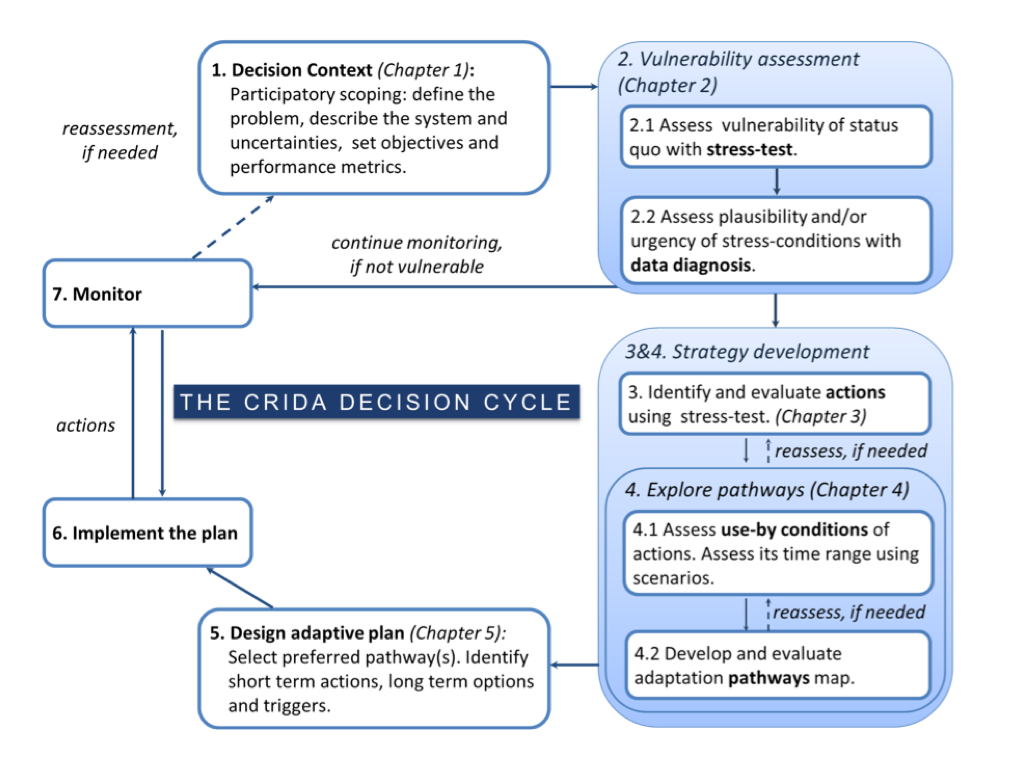
The table of contents will track the globally standardized planning cycle diagram shown here (right), illustrating the technical techniques and analysis. The document will also contain a series of case studies where the methods have applied highlighting the different points of the planning cycle, and providing keys for success, to include institutional and data limitations.
LEAD ORGANIZATIONS

*To contact members of the CRIDA team, including the Editorial & Steering Committees, click here.
PARTNERS
About AGWA
Founded in 2010, the Alliance for Global Water Adaptation (AGWA) is an informal network for water resources adaptation to climate change, focused on supporting experts, decision makers, and institutions within the water community to find common solutions for sustainable water resources management.
Navigation
Contact AGWA
Alliance for Global Water Adaptation
7640 NW Hoodview Cir.
Corvallis, Oregon 97330
USA